European mobility pilot project
DYNAMO

Linking mobility data to improve public decision-making
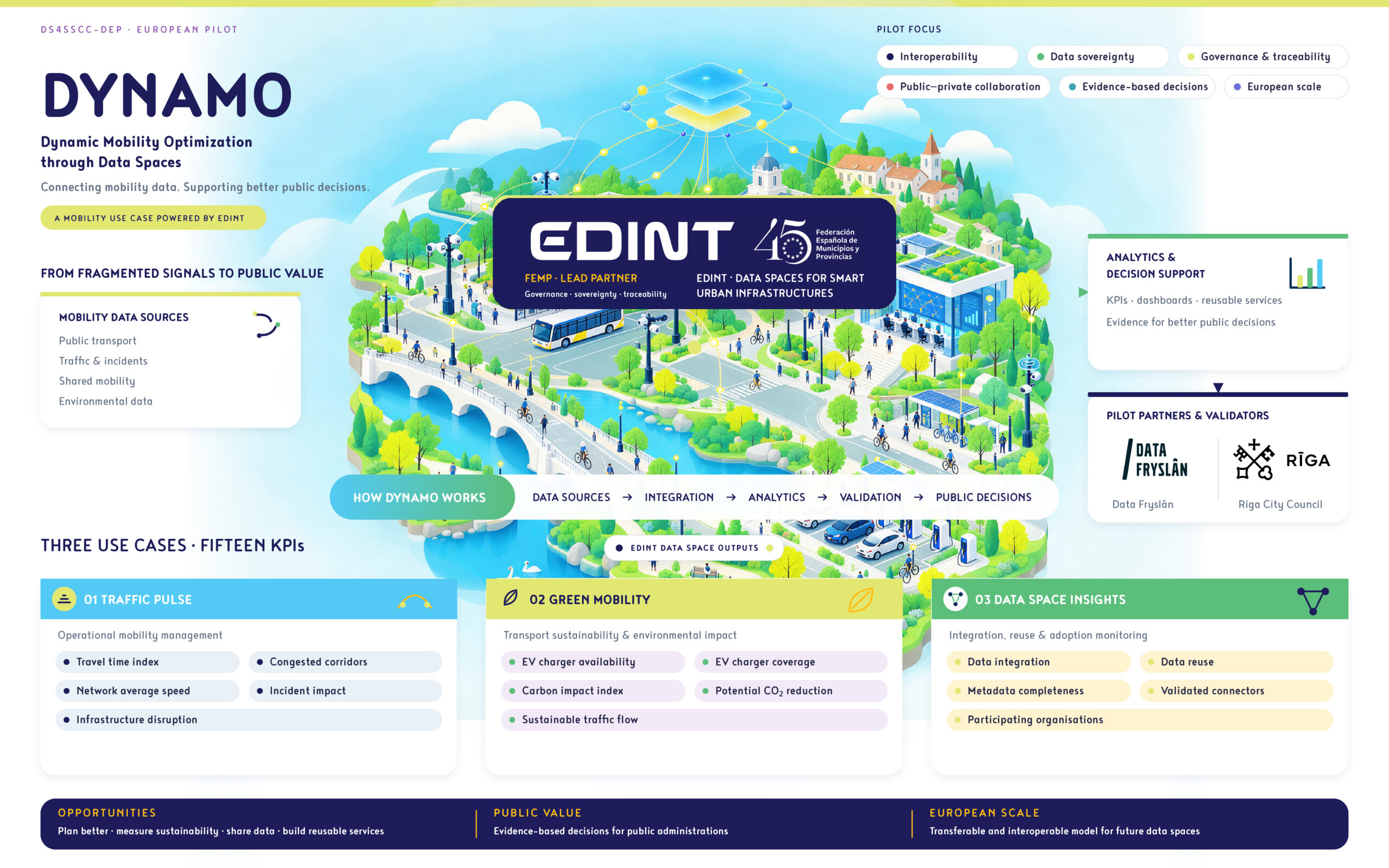
DYNAMO is a European pilot project that demonstrates how EDINT capabilities can be applied to a real-world mobility challenge, integrating data from different sources to generate useful information for public authorities.
The challenge
Mobility data already exists
The challenge is to get it to work together
01
Dispersion
Data spread across multiple systems and organisations
02
Heterogeneity
Different formats, models and levels of availability
03
Fragmented analysis
Difficulty in combining information and analysing it collectively
04
From data to decision
The need to turn fragmented data into useful information for decision-making
How it works
How DYNAMO works
DYNAMO uses EDINT as its infrastructure to integrate, govern and utilise heterogeneous mobility data. Building on this foundation, the pilot project develops analytical and visualisation capabilities that enable an understanding of how mobility functions, its sustainability aspects and the value generated by the data exchange itself.
The proposal combines an interoperable data space, standardised indicators, dashboards and AI-assisted analysis capabilities to support data-driven public decision-making
Data sources
EDINT
Integration and governance
Analytics
Visualisation and AI-assisted analysis
Public decision-making support
Various mobility and contextual data sources are incorporated into the EDINT data space, where they can be integrated and utilised in an interoperable manner. The data is transformed into indicators, analytical models, maps and dashboards that facilitate its interpretation and use by public authorities.
Data and context sources
Public transport
Traffic
Shared mobility
Fleet availability
Events
Weather
Incidents
Geospatial information
Aggregated and anonymised demographic data
Capabilities involved
- Data ingestion and integration
- Semantic standardisation
- Connectors and APIs
- Governance, access control and traceability
- Key performance indicators (KPIs) and analytical models
- Interactive maps and dashboards
- AI-assisted analytics capabilities within the scope defined for the project

Use cases
Three use cases.
A single data space
EDINT data space

Traffic Pulse
Understanding how the mobility network is performing
- Traffic conditions and journey times
- Congestion and critical corridors
- Impact of incidents, roadworks, restrictions and changes to infrastructure
- Support for monitoring network performance

Green Mobility
Analysing mobility from a sustainability perspective
- Electric vehicle charging infrastructure
- Low-emission zones
- Sustainable mobility patterns and indicators
- CO₂ reduction potential

Data Space Insights
Understanding the value generated by data sharing and reuse
- Data integration and reuse
- Participation in the ecosystem
- Quality, documentation and utilisation of datasets
- Indicators of the data space’s impact and performance
User experience
What the USER can do
Explore mobility elements and situations on a map
View the attributes and context of the elements displayed
View KPIs associated with each use case
Navigate between Traffic Pulse, Green Mobility and Data Space Insights
Access detailed information via drill-through
Export information for analysis or reuse
Run queries and explore the data using AI-assisted analytics capabilities
Pilot projects
Two European regions to validate
the approach
Riga and Fryslân are serving as pilot regions, providing data and validating the results, thereby enabling the DYNAMO approach to be tested in two different regional contexts.
Traffic Pulse, Green Mobility and Data Space Insights are being trialled in both regions.

Riga
- Urban context
- Local implementation of the pilot scheme
- Data provider and validator
- Engagement and coordination with local stakeholders
- Provides an insight into the challenges specific to a European capital

Fryslân
- Regional context
- Local implementation of the pilot
- Data provider and validator
- Involvement of and coordination with local stakeholders
- Enables the approach to be validated in a different territorial context
Two territories. Three use cases. One
interoperable approach
Validation
What is being tested
DYNAMO enables the validation, in real-world environments, of various capabilities associated with the integration, analysis and utilisation of mobility data:
Integration of heterogeneous data sources
Deployment and use of connectors
Semantic models and standardisation
Definition and visualisation of mobility indicators
Descriptive and diagnostic analytical models
Maps, dashboards and navigation between levels of information
Export and reuse of information
Use of AI-assisted capabilities to query, visualise and explain information
Validation of the approach in two real-world territorial environments
Value
Why it is relevant
Interoperability
Enables collaboration using information from different systems and stakeholders
Data sovereignty
Data exchange and reusability are managed through governance and control mechanisms
Support for decision-making
Data is transformed into indicators, analyses and visualisations that are useful for public decision-makers
Replicability
The pilot aims to generate lessons learnt and elements that can be reused in other European regions
Data quality and reusability
DYNAMO incorporates a specific approach to how shared datasets are integrated, documented and utilised
Results
Expected results
and lessons
learnt
DYNAMO aims to generate concrete and verifiable results within the scope of the pilot, as well as lessons learnt that may prove useful for future roll-outs and for other European regions.
The reporting of results will focus on demonstrable effects during the pilot’s implementation period, whilst avoiding attributing direct impacts on traffic, emissions or public behaviour that have not been measured and validated.
Integrated datasets
Connectors and interoperability mechanisms
Semantic models
Key performance indicators
Dashboards, maps and analytical capabilities
Navigation, drill-down and export functionalities
Evidence regarding transferability to other contexts
Lessons learnt on governance and implementation
Conclusions drawn from validation in Riga and Fryslân
AI-assisted analysis capabilities
Dashboards and demos
Publications and resources
Consortium
Partners

Coordinator partner
EDINT FEMP
Overall coordination, governance, management and communication

Latvia
Riga City Council / Riga Digital Agency
Implementation of the pilot, involvement of local stakeholders and validation
Netherlands
Data Fryslân / Province of Fryslân
Implementation of the pilot, involvement of local stakeholders and validation
Resources
DYNAMO at a glance: territories, focus areas and what we aim to demonstrate
A document explaining what DYNAMO is, how the three European partners are involved and what we aim to demonstrate through Traffic Pulse, Green Mobility and Data Space Insights.
Project details
Programme
DS4SSCC · European Data Space for Smart Communities (https://www.ds4sscc.eu/)
Funding framework
Digital Europe Programme
Implementation period
1 August – 31 October 2026
Total budget
€713,531.45


The grant is awarded to the FEMP as financial support to third parties within the framework of the DS4SSCC-DEP project (European Data Space for Smart Communities), managed by OASC.